









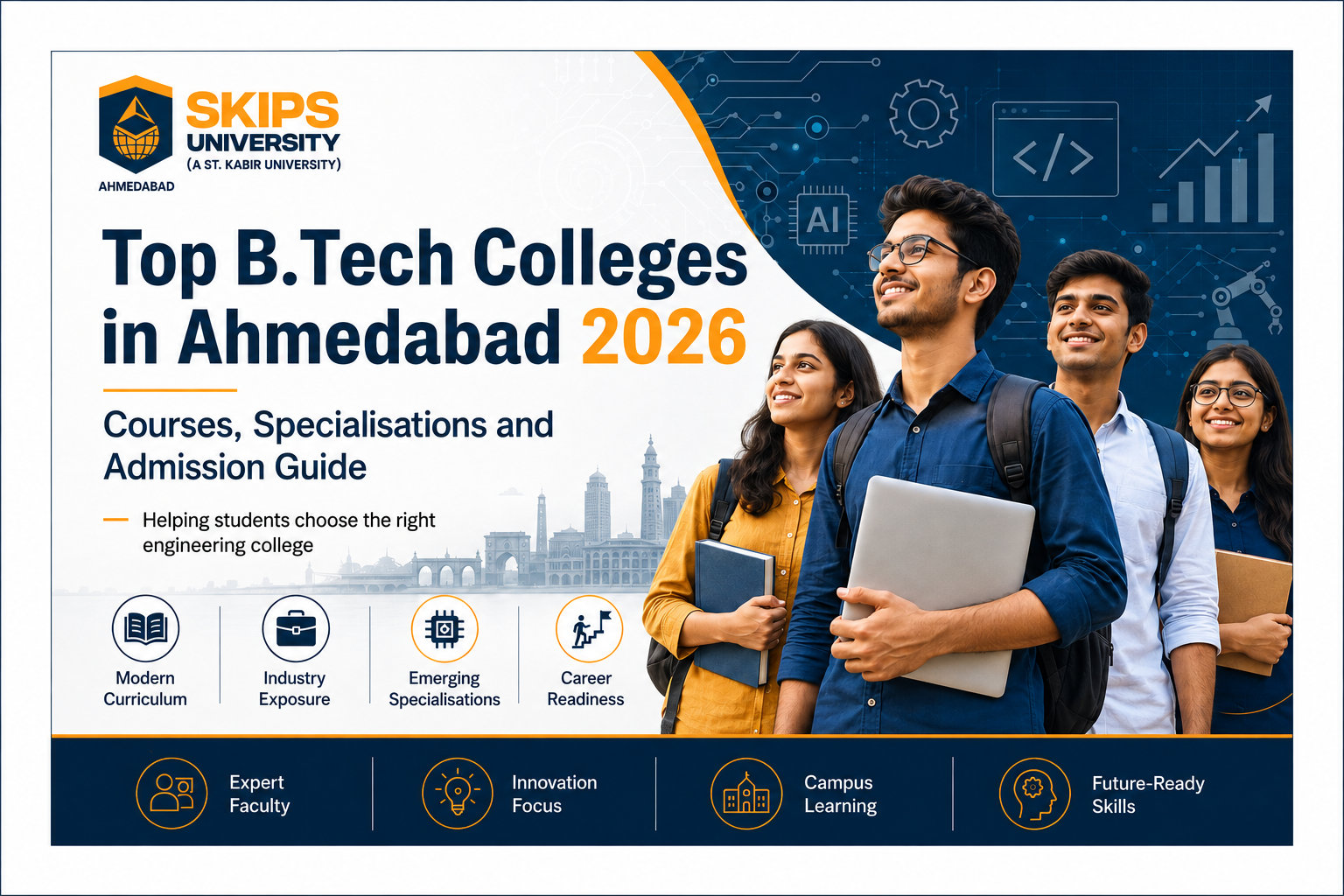
Choosing an engineering college is one of the first major career decisions a student makes after Class 12.
The college you select can influence the subjects you study, the technical skills you develop, the projects you complete, the internships you receive and the career opportunities available after graduation.
Ahmedabad has several government, private and university-based engineering institutions. Students can choose traditional branches such as Civil, Mechanical, Electrical and Electronics Engineering, as well as newer fields such as:
- Artificial Intelligence
- Machine Learning
- Data Science
- Cybersecurity
- Cloud Computing
- Computer Science and Engineering
- Information Technology
- Robotics
- VLSI and Semiconductor Technology
Some of the prominent B.Tech and engineering institutions in Ahmedabad include:
- SKIPS University
- Institute of Technology, Nirma University
- Ahmedabad University
There is no single engineering college that will be the best option for every student. One institution may be suitable for Computer Science, another may be known for traditional engineering branches, while another may offer more industry certifications and practical technology training.
This guide will help students and parents compare the leading B.Tech colleges in Ahmedabad and understand what to check before applying.
Quick answer: Some prominent B.Tech and engineering colleges in Ahmedabad include SKIPS University, Nirma University and Ahmedabad University. Students should compare the available engineering branch, curriculum, laboratories, faculty, projects, internships, fees and placement information before choosing a college.
Why Study B.Tech in Ahmedabad?
Ahmedabad is one of Gujarat’s major educational, industrial and commercial centres.
The city and the surrounding Ahmedabad–Gandhinagar region have companies operating in:
- Information technology
- Software development
- Manufacturing
- Automotive
- Pharmaceuticals
- Infrastructure
- Financial technology
- Electronics
- Renewable energy
- Textiles
- Logistics
- Consulting
- Startup development
This business environment can give engineering students opportunities to participate in industrial visits, internships, technical projects, hackathons and professional networking activities.
Ahmedabad also offers students:
- Government and private engineering colleges
- A wide selection of engineering branches
- Access to technology companies and startups
- Opportunities for practical projects
- Competitive examinations and higher-study preparation
- Relatively manageable living costs compared with some larger metropolitan cities
- Access to the wider Ahmedabad–Gandhinagar education and technology ecosystem
The actual quality of these opportunities will depend on the institution, programme, faculty, industry relationships and the student’s own participation.
Top B.Tech Colleges in Ahmedabad: Quick Comparison
| College or university | Main engineering options | Suitable for |
| SKIPS University | Computer Science and Information Technology with IBM-supported curriculum | Students interested in software, AI, data science, cloud and cybersecurity |
| Nirma University | CSE, AI and ML, Civil, Chemical, Electrical, Mechanical, ECE, VLSI and related branches | Students seeking multiple engineering branches and structured admission routes |
| Ahmedabad University | CSE, Chemical and Environmental, Electrical and Electronics, Mechanical Engineering | Students interested in interdisciplinary and project-based engineering education |
| L.D. College of Engineering | Multiple government engineering programmes | Students seeking an established government engineering college |
| LJ University | Computer, IT, AI and ML, Robotics, Mechanical, Civil, Chemical and ECE | Students looking for a broad selection of conventional and emerging branches |
| Silver Oak University | CSE, Computer Engineering, AI and ML, Cybersecurity, IT, Civil, Mechanical and other branches | Students seeking multiple specialised technology programmes |
| Indus University | CSE, Computer Engineering, IT, Civil, Mechanical, Electrical, ECE and related branches | Students interested in a multidisciplinary private university |
This comparison is not an official government ranking. The right college depends on the student’s branch preference, entrance score, budget, location and long-term career plans.
1. SKIPS University
SKIPS University offers a four-year B.Tech programme in Computer Science and Information Technology.
The university states that its B.Tech curriculum has been enriched and co-designed through its collaboration with IBM. The programme focuses on computer science foundations along with newer areas of technology, including artificial intelligence, data science, cybersecurity and cloud computing.
What Students Learn
The curriculum includes subjects such as:
- Programming
- Data Structures
- Object-Oriented Programming
- Computer Organisation and Architecture
- Computer Networks
- Database Management Systems
- Software Engineering
- Artificial Intelligence
- Data Science
- Cybersecurity
- Web Development
- Cloud Computing
- Data Visualisation
- Natural Language Processing
- Computer Vision
- Data Warehousing and Mining
- Generative AI and Prompt Engineering
The university’s published curriculum also includes IBM-linked subjects such as Python Programming for Data Science, Data Visualisation, Generative AI and advanced artificial intelligence programming.
Tools and Technology Exposure
Students are introduced to tools and platforms used in modern technology roles, including:
- Python
- Java
- C and C++
- Tableau
- Power BI
- Hadoop
- Microsoft Azure
- Google Cloud
- Amazon Web Services
- VMware
- IBM Watson
Learning a tool does not automatically make a student job-ready. However, regular practical assignments and projects can help students understand how these technologies are used to solve real problems.
Practical Learning Structure
The B.Tech programme page highlights:
- More than 2,300 hours of active learning
- More than 600 hours of project work
- More than 250 hours of hands-on training
- More than 170 hours of language training
- More than 110 hours of employability-skills development
- More than 10 industry certifications
The programme also includes an industry internship or major project during the final semester.
Industry Certifications
Students may receive exposure to certification pathways connected with:
- AWS Cloud
- Microsoft Azure
- Machine Learning
- Data Science
- Power BI
- Cybersecurity
- Virtual internships
Certification availability, examination costs and eligibility may change. Students should confirm which certifications are included in the programme fee and which require separate payment.
Career Opportunities
Graduates of a Computer Science and Information Technology programme can explore entry-level roles such as:
- Software Developer
- Web Developer
- Data Analyst
- Quality Assurance Engineer
- Network Engineer
- Systems Analyst
- Cybersecurity Analyst
- Cloud Support Engineer
- Business Analyst
- Technology Consultant
- AI or Machine Learning Engineer
- Database Administrator
- Product Support Engineer
The exact role a student receives will depend on technical ability, projects, internships, communication skills and recruitment conditions.
Who Should Consider SKIPS University?
SKIPS University may be suitable for students who want:
- Tech in Computer Science and Information Technology
- An IBM-supported curriculum
- Exposure to artificial intelligence and data science
- Cloud-computing and cybersecurity skills
- Industry certifications
- Project-based learning
- Communication and employability training
- A technology programme focused mainly on the IT industry
Students looking specifically for Civil, Mechanical or Electrical Engineering should compare other institutions because the SKIPS programme is primarily focused on Computer Science and Information Technology.
2. Institute of Technology, Nirma University
The Institute of Technology at Nirma University offers several B.Tech programmes through its School of Engineering and School of Technology.
The available branches for 2026 include:
- Computer Science and Engineering
- Computer Science and Engineering with Artificial Intelligence and Machine Learning
- Chemical Engineering
- Civil Engineering
- Electrical Engineering
- Electronics and Communication Engineering
- Electronics and Instrumentation Engineering
- Electronics Engineering in VLSI Design and Semiconductor Technology
- Mechanical Engineering
Students pursue a major in their selected engineering branch. The university also provides opportunities to explore minor subjects outside the student’s primary discipline.
Admission Routes
Nirma University offers different admission categories.
Government or state-quota seats are generally filled through Gujarat’s Admission Committee for Professional Courses. The merit process considers qualifying-examination performance and GUJCET results.
All-India seats are filled using JEE Main rankings, while separate provisions apply to NRI and NRI-sponsored categories.
Students should confirm the latest rules because seat numbers, entrance requirements and admission categories may change.
Who Should Consider Nirma University?
Nirma University may be suitable for students who want:
- A broad selection of engineering branches
- Computer Science or AI and Machine Learning
- VLSI and semiconductor-related education
- Major and minor combinations
- JEE Main or ACPC-based admission routes
- An established private engineering institute
- Access to postgraduate and research opportunities
The university may have competitive cut-offs, particularly for Computer Science and related programmes.
3. Ahmedabad University
Ahmedabad University offers a four-year Bachelor of Technology programme through its School of Engineering and Applied Science.
The B.Tech programme currently offers four majors:
- Chemical and Environmental Engineering
- Computer Science and Engineering
- Electrical and Electronics Engineering
- Mechanical Engineering
Students complete engineering-foundation subjects that are common across disciplines before developing deeper expertise in their chosen major.
The programme uses a project-based and design-oriented approach intended to develop complex problem-solving, engineering design and innovation skills.
Admission Eligibility
For 2026 admission, applicants must have completed Class 12 or an equivalent qualification with Physics and Mathematics. Chemistry is additionally required for applicants selecting Chemical and Environmental Engineering.
The university accepts recognised engineering entrance examination scores according to its current admission process.
Who Should Consider Ahmedabad University?
Ahmedabad University may suit students who want:
- An interdisciplinary academic environment
- Project-based engineering education
- Computer Science and Engineering
- Chemical and Environmental Engineering
- Electrical and Electronics Engineering
- Mechanical Engineering
- Opportunities to study subjects outside the engineering discipline
- A strong focus on design, research and problem-solving
Students should compare the programme fee, admission requirements, financial aid and campus experience before applying.
4. L.D. College of Engineering
Lalbhai Dalpatbhai College of Engineering, commonly known as LDCE, is a government engineering college located in Navrangpura, Ahmedabad.
The college is located near major academic and research institutions such as Gujarat University, the Physical Research Laboratory, ATIRA, ISRO, IIM Ahmedabad and CEPT University.
LDCE offers undergraduate engineering programmes across multiple traditional and technology-focused disciplines.
The college’s 2026 programme information includes branches such as:
- Artificial Intelligence and Machine Learning
- Automobile Engineering
- Civil Engineering
- Computer Engineering
- Electrical Engineering
- Electronics and Communication Engineering
- Information Technology
- Instrumentation and Control Engineering
- Mechanical Engineering
- Robotics and Automation
- Rubber Technology
- Textile Technology
Students should verify the final branch list and seat matrix from the current ACPC admission documents.
Admission Process
Admission to the first year of undergraduate engineering programmes at LDCE is managed centrally through ACPC.
Because LDCE is a government institution, it generally attracts students seeking:
- Government-college fees
- Established engineering departments
- A central Ahmedabad location
- Traditional engineering branches
- Competitive ACPC-based admission
- A large alumni network
Admission can be highly competitive, especially in Computer Engineering, Information Technology and other high-demand branches.
5. Institute of Infrastructure, Technology, Research and Management
The Institute of Infrastructure, Technology, Research and Management, better known as IITRAM, is an autonomous university established by the Government of Gujarat and located in Maninagar, Ahmedabad.
IITRAM offers four-year B.Tech programmes in:
- Computer Engineering
- Civil Engineering
- Electrical Engineering
- Mechanical Engineering
The programme is designed to combine core technical competence with problem-solving, ethical reasoning and interdisciplinary thinking.
Who Should Consider IITRAM?
IITRAM may be suitable for students who want:
- A government-established university
- Computer Engineering
- Civil Engineering
- Electrical Engineering
- Mechanical Engineering
- Technical education combined with interdisciplinary exposure
- ACPC-based engineering admission
- A campus located within Ahmedabad
Students should check current cut-offs, seat availability, fee details and scholarship rules through the official admission process.
6. LJ University
LJ Institute of Engineering and Technology, under LJ University, offers undergraduate engineering programmes in conventional and emerging disciplines.
The available programmes include:
- Artificial Intelligence and Machine Learning
- Artificial Intelligence and Data Science
- Chemical Engineering
- Civil Engineering
- Computer Engineering
- Computer Science and Design
- Electronics and Communication Engineering
- Information Technology
- Mechanical Engineering
- Robotics and Artificial Intelligence
This branch selection can be useful for students who are deciding between a conventional engineering degree and a technology-focused specialisation.
Admission Process
The university states that engineering admission is based on GUJCET or JEE Main, along with qualifying-examination performance under the applicable admission process.
Students applying through Gujarat’s central system should confirm seat availability and branch cut-offs through ACPC.
Who Should Consider LJ University?
LJ University may be suitable for students who want:
- A broad choice of engineering branches
- Artificial Intelligence and Machine Learning
- Robotics and Artificial Intelligence
- Computer Science and Design
- Information Technology
- A large multidisciplinary campus
- Practical activities and technical competitions
- An Ahmedabad-based private university
Students should compare the curriculum of AI, AI and Data Science, Computer Engineering and Information Technology carefully because these programmes can have several overlapping subjects.
7. Silver Oak University
Silver Oak University offers engineering programmes through the Silver Oak College of Engineering and Technology and the Aditya Silver Oak Institute of Technology.
The university currently lists branches such as:
- Computer Science and Engineering
- Computer Engineering
- Computer Engineering with AI and Machine Learning
- Computer Science and Engineering with Cybersecurity
- Information Technology
- Biotechnology
- Aerospace Engineering
- Aeronautical Engineering
- Chemical Engineering
- Civil Engineering
- Electrical Engineering
- Electronics and Communication Engineering
- Mechanical Engineering
The Computer Engineering department at Aditya Silver Oak Institute of Technology is listed as NBA-accredited on the university’s programme page.
Who Should Consider Silver Oak University?
Silver Oak University may be suitable for students who want:
- Multiple Computer Science-related options
- AI and Machine Learning
- Cybersecurity
- Aerospace or Aeronautical Engineering
- Biotechnology
- A large private-university environment
- Different engineering institutes within one university
- Several fee and branch options
Students should confirm exactly which institute offers their selected programme because the programme fee, accreditation status and facilities may differ between institutes.
8. Indus University
Indus University offers four-year B.Tech programmes through the Indus Institute of Technology and Engineering.
Its engineering options include:
- Automobile Engineering
- Civil Engineering
- Computer Engineering
- Computer Science and Engineering
- Electrical Engineering
- Electronics and Communication Engineering
- Information Technology
- Mechanical Engineering
- Metallurgical Engineering
The university also promotes specialised programmes connected with areas such as:
- Artificial Intelligence and Data Science
- Cybersecurity
- Aerospace Engineering
- Aeronautical Engineering
- Aircraft Maintenance Engineering
The exact title, approval structure and eligibility of specialised aerospace programmes should be verified before admission.
Admission Process
Indus University states that a portion of its engineering seats is filled through ACPC merit, while management-quota admissions are handled by the institution under applicable ACPC guidelines.
Who Should Consider Indus University?
Indus University may be suitable for students who want:
- Computer Science or Information Technology
- Traditional engineering branches
- Aerospace and aviation-related options
- Entrepreneurship support
- Project and fieldwork exposure
- A multidisciplinary university campus
Students should compare branch-specific laboratories, faculty, placement information and fees instead of evaluating the university only through its general branding.
Which Is the Best B.Tech College in Ahmedabad?
The best B.Tech college will depend on the student’s branch, entrance score, budget and career plans.
A student looking for Computer Science with industry certifications will have different priorities from someone looking for Civil Engineering at a government college.
Here is a more practical comparison.
For Computer Science and IT
Students interested in Computer Science, software development and IT can consider:
- SKIPS University
- Nirma University
- Ahmedabad University
- D. College of Engineering
- IITRAM
- LJ University
- Silver Oak University
- Indus University
Before selecting a college, compare:
- Programming subjects
- Data Structures and Algorithms
- Software engineering
- Database systems
- Cloud computing
- Artificial intelligence
- Cybersecurity
- Industry certifications
- Coding clubs
- Hackathons
- Internships
- Final-year projects
The name of the branch alone does not determine the quality of the programme.
For Artificial Intelligence and Machine Learning
Students interested in AI and Machine Learning can examine programmes at:
- Nirma University
- LJ University
- Silver Oak University
- D. College of Engineering
- SKIPS University through its Computer Science and IT curriculum
Check whether AI is offered as a complete branch, a specialisation, an elective group or only a few individual subjects.
A good AI-focused programme should still build strong foundations in:
- Programming
- Mathematics
- Data Structures
- Algorithms
- Databases
- Computer Networks
- Operating Systems
- Software Engineering
Students should not select an AI course that removes essential Computer Science fundamentals.
For Government Engineering Education
Students looking for a government or government-established institution can consider:
- D. College of Engineering
- IITRAM
Government institutions may provide comparatively lower tuition fees, but admission can be highly competitive.
Students should compare:
- Branch cut-offs
- Faculty availability
- Laboratory facilities
- Hostel availability
- Placement support
- Campus infrastructure
- Distance from home
For Traditional Engineering Branches
Students interested in Civil, Mechanical, Electrical or Chemical Engineering can evaluate:
- Nirma University
- Ahmedabad University
- D. College of Engineering
- IITRAM
- LJ University
- Silver Oak University
- Indus University
SKIPS University is better suited to students specifically seeking Computer Science and Information Technology.
For Industry Certifications and Technology Tools
Students interested in certifications and software-platform exposure can consider SKIPS University, particularly for areas such as:
- AWS
- Microsoft Azure
- Power BI
- Data Science
- Cloud Computing
- Cybersecurity
- Artificial Intelligence
Students should verify whether certification examination fees are included and whether training is delivered by certified instructors.
B.Tech Admission Process in Ahmedabad
B.Tech admission varies by institution and seat category.
For many Gujarat engineering colleges, ACPC manages the central admission process.
The 2026 ACPC process includes:
- Online registration
- Document verification
- Merit preparation
- Choice filling
- Seat allotment
- Fee payment
- Admission confirmation
- Reporting to the allotted institution
ACPC publishes separate schedules, seat matrices, round-wise allotment information and reporting instructions for B.E. and B.Tech admission.
Some private universities also accept applications directly for:
- JEE Main-based seats
- Management-quota seats
- Institutional merit seats
- NRI or NRI-sponsored seats
- University-specific admission categories
Students should apply through the correct admission channel. Submitting a university enquiry form does not always mean the student has completed the official ACPC registration.
Common B.Tech Eligibility Requirements
Eligibility varies by branch and institution.
In general, applicants may need:
- Class 12 or equivalent qualification
- Physics and Mathematics
- Chemistry or another permitted subject, depending on the branch
- The required minimum aggregate marks
- GUJCET, JEE Main or another accepted entrance score
- ACPC registration for applicable Gujarat seats
Students applying for branches such as Chemical, Civil or Mechanical Engineering may have different subject requirements from those applying for certain Computer Science-related programmes.
Always verify eligibility from the official university and ACPC information before paying an application or admission fee.
How to Choose the Right B.Tech College
1. Select the Branch First
Do not choose a college before deciding which engineering field genuinely interests you.
Think about whether you enjoy:
- Coding and software
- Machines and manufacturing
- Electronics and circuits
- Construction and infrastructure
- Chemistry and industrial processes
- Data and artificial intelligence
- Robotics and automation
- Aviation and aerospace
Changing branches after admission may be difficult or impossible.
2. Compare the Complete Curriculum
Read the semester-wise syllabus.
For Computer Science, check for:
- C, C++, Java or Python
- Data Structures
- Algorithms
- Database Management
- Operating Systems
- Computer Networks
- Software Engineering
- Cloud Computing
- Artificial Intelligence
- Cybersecurity
- Web or mobile development
- Projects and internships
Do not choose a programme only because it uses words such as “AI-powered,” “future-ready” or “industry-integrated.”
3. Check Laboratory Facilities
A college should provide branch-specific laboratories.
For Computer Science, check:
- Computer configuration
- Licensed software
- Cloud access
- Cybersecurity labs
- Networking labs
- AI and data-science tools
For core engineering branches, inspect:
- Mechanical workshops
- Civil engineering labs
- Electrical machines
- Electronics labs
- Manufacturing equipment
- Material-testing facilities
Visit the campus and ask whether students regularly use the laboratories.
4. Examine Faculty Profiles
Check:
- Faculty qualifications
- Teaching experience
- Industry experience
- Research areas
- Publications
- Patents
- Projects
- Professional certifications
A programme needs experienced faculty across core subjects, not just visiting speakers.
5. Check Project-Based Learning
Ask the college:
- How many projects will students complete?
- Are projects individual or group-based?
- Does the college conduct hackathons?
- Are there industry problem statements?
- Are students encouraged to publish research?
- Does the university support patents and startups?
- Is there a mandatory final-year project?
Strong projects can be more useful during placement interviews than marks alone.
6. Verify Internship Support
Ask for branch-specific internship information.
Check:
- Internship duration
- Internship partner names
- Paid or unpaid opportunities
- Technical roles offered
- Faculty supervision
- Student selection process
- Whether internships are guaranteed or only assisted
- Previous student internship examples
Do not assume every company logo represents an engineering internship partner.
7. Study Placement Data Carefully
Check whether placement information is:
- University-wide
- Engineering-specific
- Branch-specific
- Based only on participating students
- Based on all eligible students
- For the current academic year
Ask for:
- Number of eligible students
- Number who participated
- Number placed
- Placement percentage
- Average package
- Median package
- Highest package
- Job roles
- Recruiter names
- Internship conversion rate
“Placement assistance” is not the same as guaranteed placement.
8. Compare Total Fees
Calculate the full four-year cost.
Include:
- Tuition fees
- Registration fees
- Examination fees
- Laboratory fees
- Certification fees
- Hostel fees
- Transportation
- Laptop cost
- Software cost
- Deposits
- Industrial visits
- Study tours
- Re-examination fees
Ask for the written fee structure and refund policy.
9. Check Accreditation and Recognition
Students should verify:
- University recognition
- AICTE-related status where applicable
- Institutional accreditation
- Programme-level NBA accreditation
- Validity of specialised programmes
- Degree-awarding authority
NBA accreditation may apply only to a particular department or programme, not the complete university.
10. Visit the Campus
A campus visit can answer questions that a brochure cannot.
During the visit:
- Inspect laboratories
- Speak with current students
- Meet faculty members
- Visit the library
- Check transport arrangements
- View hostel facilities
- Ask about attendance rules
- Review student projects
- Understand the placement process
Avoid making a four-year decision only through advertisements or counselling calls.
Popular B.Tech Branches and Career Options
Computer Science and Engineering
Possible roles include:
- Software Developer
- Full-Stack Developer
- Cloud Engineer
- Data Analyst
- Cybersecurity Analyst
- DevOps Engineer
- Quality Assurance Engineer
- Systems Engineer
Artificial Intelligence and Machine Learning
Possible roles include:
- Machine Learning Engineer
- AI Engineer
- Data Scientist
- Computer Vision Engineer
- Natural Language Processing Engineer
- Data Analyst
Most specialised AI roles require strong projects, advanced skills or postgraduate study.
Information Technology
Possible roles include:
- Software Developer
- System Administrator
- Network Engineer
- IT Consultant
- Cloud Support Engineer
- Database Administrator
- Web Developer
Electronics and Communication Engineering
Possible roles include:
- Electronics Engineer
- Embedded Systems Engineer
- Telecom Engineer
- VLSI Engineer
- Network Engineer
- Hardware Testing Engineer
Mechanical Engineering
Possible roles include:
- Design Engineer
- Production Engineer
- Manufacturing Engineer
- Maintenance Engineer
- Quality Engineer
- Automobile Engineer
Civil Engineering
Possible roles include:
- Site Engineer
- Structural Engineer
- Project Coordinator
- Quantity Surveyor
- Construction Planner
- Infrastructure Consultant
Electrical Engineering
Possible roles include:
- Electrical Design Engineer
- Power Systems Engineer
- Maintenance Engineer
- Control Systems Engineer
- Renewable Energy Engineer
- Automation Engineer
Why Consider B.Tech at SKIPS University?
For students specifically looking for a Computer Science and Information Technology programme, SKIPS University offers a technology-focused curriculum developed with industry exposure in mind.
Its major programme features include:
- Four-year B.Tech in Computer Science and Information Technology
- Curriculum enriched and co-designed with IBM
- Artificial Intelligence and Machine Learning
- Data Science and Visualisation
- Cybersecurity
- Cloud Computing
- Full-Stack Development
- More than 600 hours of project work
- More than 250 hours of hands-on training
- More than 10 industry-certification pathways
- Language and employability-skills training
- Final-semester internship or major project
The programme may be relevant for students who want to build careers in software, data, cloud, cybersecurity and emerging technology.
Students should review the latest eligibility criteria, fee structure, admission process, scholarship rules and placement information directly with the university before applying.
Frequently Asked Questions
Which are the top B.Tech colleges in Ahmedabad?
Prominent B.Tech and engineering colleges in Ahmedabad include SKIPS University, Nirma University, Ahmedabad University, L.D. College of Engineering, IITRAM, LJ University, Silver Oak University and Indus University.
The right college depends on the student’s engineering branch, entrance score, budget and career goals.
Which is the best B.Tech college in Ahmedabad for Computer Science?
Students can consider Nirma University, Ahmedabad University, L.D. College of Engineering, IITRAM, SKIPS University, LJ University, Silver Oak University and Indus University for Computer Science-related education.
Compare curriculum, coding culture, projects, faculty, internships, certifications and branch-specific placements before deciding.
Does SKIPS University offer B.Tech?
Yes. SKIPS University offers a four-year B.Tech in Computer Science and Information Technology. Its curriculum is enriched and co-designed through collaboration with IBM.
What technology subjects are covered at SKIPS University?
The curriculum includes programming, data structures, databases, software engineering, artificial intelligence, machine learning, data science, cloud computing, cybersecurity, computer networks, web development and Generative AI.
Which entrance exams are accepted for B.Tech admission in Ahmedabad?
Depending on the institution and seat category, admission may be based on GUJCET, JEE Main, ACPC merit or an institution-specific selection process.
Students should check the official admission rules for each university.
Is GUJCET compulsory for B.Tech admission in Ahmedabad?
GUJCET is commonly used for Gujarat state-quota engineering admissions through ACPC. Some private universities also offer JEE Main, institutional, management, NRI or other admission categories.
Can students get B.Tech admission without JEE Main?
Yes, some Gujarat engineering seats are filled through GUJCET and ACPC, while some private universities have institutional or management-quota admission routes.
Eligibility and admission rules vary by college.
Which B.Tech branch has the best scope?
There is no single branch that is best for everyone.
Computer Science, AI, Data Science and Cybersecurity currently attract significant student interest. However, Mechanical, Civil, Electrical, Chemical and Electronics Engineering continue to have opportunities in manufacturing, infrastructure, energy, construction, automotive and related industries.
Students should select a branch based on interest and aptitude rather than market popularity alone.
Is Artificial Intelligence better than Computer Science?
Artificial Intelligence is a specialised area within the wider computing field.
A broad Computer Science programme may offer more flexibility, while an AI-focused programme provides deeper exposure to machine learning, data and intelligent systems.
Students should ensure that an AI programme still teaches core Computer Science subjects.
What is the duration of B.Tech?
A regular B.Tech degree generally takes four years and is divided into eight semesters.
Diploma holders may be eligible for lateral-entry admission under applicable rules.
What should students check before joining a B.Tech college?
Students should check:
- Branch curriculum
- Faculty
- Laboratories
- Projects
- Internships
- Placement statistics
- Accreditation
- Total fees
- Admission route
- Campus facilities
- Student reviews
- Distance and transport
Is B.Tech from Ahmedabad good for a career?
Ahmedabad offers engineering institutions, technology companies, manufacturing industries, startups and access to the wider Ahmedabad–Gandhinagar business region.
Career success will still depend on the student’s technical skills, projects, internships, communication and willingness to continue learning.
Final Thoughts
Choosing among the top B.Tech colleges in Ahmedabad requires more than comparing rankings or advertisements.
Students should begin by selecting the right engineering branch. After that, they should compare the curriculum, laboratories, faculty, projects, internships, fees and placement outcomes of each college.
Before paying an admission fee:
- Read the complete semester-wise syllabus.
- Verify the admission route.
- Check the latest ACPC information.
- Visit the campus.
- Inspect laboratories.
- Speak with current students.
- Ask for branch-specific placement data.
- Calculate the total four-year cost.
- Review scholarship conditions.
- Confirm all information in writing.
Students interested in software engineering, artificial intelligence, data science, cloud computing and cybersecurity can explore the B.Tech in Computer Science and Information Technology offered by SKIPS University.
Start Your Engineering Journey at SKIPS University
Build technical skills through programming, projects, industry tools, certifications and practical learning.
Explore the B.Tech in Computer Science and Information Technology with a curriculum enriched and co-designed with IBM.
Admissions Enquiry: +91 95121 30000
Email: info@skipsuniversity.edu.in
Programme names, eligibility, fees, admission criteria, industry collaborations, certifications and placement information may change. Students should verify the latest information from the respective college or university before applying.


