










Think about the last time you watched a show on Netflix or bought something online.
Netflix may have recommended a series based on what you watched earlier. An online shopping platform may have suggested a product that matched your recent searches. Your bank may have sent an alert after noticing an unusual transaction.
These decisions are not based on guesswork.
They are made using data.
Companies collect information about customers, sales, products, payments and business operations. Business analytics helps them study this information, identify patterns and make better decisions.
This is why organisations now need professionals who understand both business and data.
A PGDM in Business Analytics is designed for students who want to build this combination of skills. It brings together management education, analytical thinking, technology and practical business problem-solving.
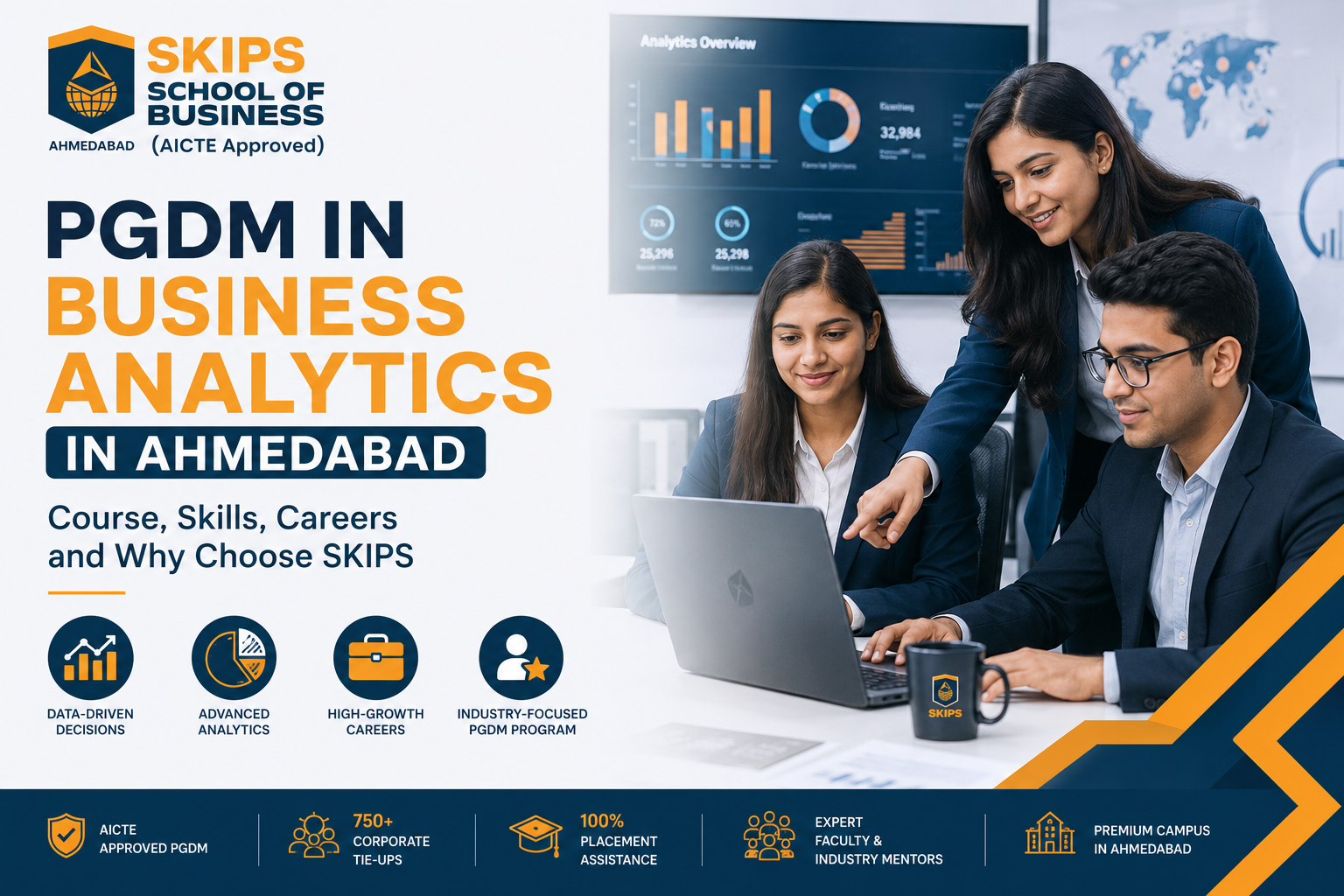
At SKIPS School of Business, Ahmedabad, the PGDM in Business Analytics is a two-year, full-time programme offered in collaboration with IBM. The programme includes management subjects as well as Business Analytics topics such as Python, database management, cloud computing, artificial intelligence, machine learning, data visualisation and predictive analytics.
Quick Answer: What Is PGDM in Business Analytics?
PGDM in Business Analytics is a postgraduate management programme that teaches students how to use data to understand and solve business problems.
Students learn how to:
- Collect and organise business data
- Study trends and patterns
- Understand customer behaviour
- Measure business performance
- Present data clearly
- Make forecasts
- Support management decisions
- Use analytical and technology tools
- Connect data findings with business goals
The programme is not only about coding or mathematics. It also teaches management, communication, marketing, finance, operations, strategy and leadership.
This makes it suitable for students who want to work between business teams and technical teams.
What Is Business Analytics?
Business analytics is the use of data, statistical methods and technology to understand business performance and support better decisions.
IBM describes business analytics as the use of statistical methods and computing technologies to process, study and visualise data. The goal is to find useful patterns, relationships and insights that can improve business decisions.
In simple words, business analytics helps answer questions such as:
- Why are sales falling in one city?
- Which customers are most likely to buy again?
- Which advertising campaign is producing better results?
- Which products should a store keep in stock?
- Which loan applications may carry more risk?
- Why are customers leaving a mobile application?
- What could demand look like next month?
- Which business process is taking too much time?
The analyst studies available data and turns it into an answer that managers can use.
A Simple Business Analytics Example
Imagine that a retail company has 50 stores.
The company knows that sales are lower in ten stores, but it does not know why.
A business analyst may study:
- Product availability
- Customer footfall
- Local demand
- Competitor pricing
- Staff performance
- Advertising activity
- Seasonal trends
- Customer complaints
- Online and offline sales
After studying the data, the analyst may find that popular products are regularly out of stock in those ten stores.
The company can then improve its inventory planning instead of spending more money on advertising.
That is the practical value of business analytics. It helps companies understand the real problem before making a decision.
Why Is Business Analytics Important Today?
Almost every organisation creates data.
A bank creates transaction data. A hospital creates patient and service data. An online store records searches, purchases and returns. A manufacturing company tracks production, quality and delivery. A marketing team measures clicks, leads and conversions.
However, collecting data is not enough.
Companies need people who can:
- Ask the right questions
- Select useful information
- Check data quality
- Understand what the numbers mean
- Explain the findings
- Recommend practical actions
Business analytics connects raw information with business decisions.
The World Economic Forum’s Future of Jobs Report 2025 identifies AI and big data among the fastest-growing skills expected through 2030. It also identifies big data specialists and AI and machine-learning specialists among the fastest-growing roles. At the same time, employers continue to value human skills such as analytical thinking, leadership, communication, resilience and collaboration.
This combination is important.
Companies do not only need people who can use a tool. They need professionals who can understand a business problem, analyse relevant data and explain what should happen next.
What Is the Difference Between Data Analytics and Business Analytics?
These terms are often used together, but they are not always identical.
Data Analytics
Data analytics mainly focuses on studying data.
A data analyst may clean information, prepare reports, create dashboards and identify patterns.
Business Analytics
Business analytics connects those findings with a business decision.
A business analytics professional may ask:
- What is causing the problem?
- What could happen in the future?
- Which action should the company take?
- How will the action affect revenue, cost or customers?
Business analytics therefore combines data skills with management understanding.
A PGDM in Business Analytics is useful for students who want to understand both sides.
Types of Business Analytics
Business analytics is commonly understood through four types.
1. Descriptive Analytics
Descriptive analytics explains what has already happened.
Examples include:
- Monthly sales reports
- Website traffic reports
- Customer complaint summaries
- Product return reports
- Employee attendance reports
It gives managers a clear picture of past performance.
2. Diagnostic Analytics
Diagnostic analytics explains why something happened.
For example:
Sales may have fallen because a product was unavailable, a competitor reduced prices or a campaign reached the wrong customers.
3. Predictive Analytics
Predictive analytics uses past data to estimate what may happen next.
It may be used to predict:
- Customer demand
- Loan default risk
- Product sales
- Employee turnover
- Customer churn
- Equipment failure
A prediction is not a guarantee. It is an informed estimate based on available information.
4. Prescriptive Analytics
Prescriptive analytics suggests what action may produce a better result.
For example, it may help a company decide:
- How much stock to order
- Which customer group to target
- How to schedule deliveries
- Which price to offer
- Where to open a new store
Students should understand all four types because business decisions often move from understanding the past to planning the future.
About the PGDM in Business Analytics at SKIPS
The PGDM in Business Analytics at SKIPS School of Business is a two-year, full-time postgraduate management programme.
The official programme page states that it is offered in collaboration with IBM and is designed to prepare students for data-driven business roles.
The programme combines:
- General management education
- Business Analytics subjects
- Communication training
- Employability development
- Live projects
- Industry exposure
- Internship experience
- Case-based learning
The first part of the programme builds a foundation in management. Students later study specialised subjects connected with analytics, technology and business decision-making.
Collaboration with IBM
SKIPS presents IBM as the industry collaborator for its PGDM in Business Analytics programme.
The value of an industry collaboration should be judged by what students actually receive through it.
Students considering the programme should ask:
- Which subjects include IBM learning content?
- Are IBM professionals involved in any sessions?
- Which IBM tools or platforms are used?
- Does the programme include an IBM certificate?
- Are certification fees included in the course fee?
- Are certificates issued to every student or only after an assessment?
- How many IBM-supported sessions are conducted?
- Does the collaboration apply to the complete programme or selected modules?
These questions give students a clearer understanding of the collaboration.
The official programme page currently confirms that the programme is offered in collaboration with IBM, but applicants should request the latest written details for the 2026 admission batch.
Is the PGDM in Business Analytics Approved by AICTE?
The official SKIPS course listing describes the PGDM in Business Analytics as an AICTE-approved programme. SKIPS also states that its PGDM offering is approved by the All India Council for Technical Education.
Students should still ask for the latest AICTE approval letter before taking admission.
Check:
- The exact name of the institution
- The programme name
- The approved intake
- The academic year
- The campus address
- The approval status
This is good practice when applying to any PGDM institution.
PGDM in Business Analytics Course Structure
The programme is divided into six trimesters.
The first three trimesters focus on general management, communication, statistics and basic business understanding. Later trimesters include internships, strategy and specialised elective subjects.
First Trimester: Management and Data Foundations
The first trimester includes:
- Management Concepts and Practices
- Financial and Cost Accounting
- Fundamentals of Marketing Management
- Statistics for Managers
- Computer Skills for Managers
- English-language training
- Soft-skills training
- Live Project I
Statistics is especially important for Business Analytics students because it helps them understand averages, relationships, variation and probability.
At the same time, accounting and marketing help students understand the business meaning behind the numbers.
Second Trimester: Understanding Business Functions
The second trimester includes:
- Communication Skills
- Financial Management
- Managerial Economics
- Organisational Behaviour
- Management Information Systems
- English-language training
- Soft-skills training
- Live Project II
A business analyst often works with people from finance, marketing, human resources, operations and technology.
These subjects help students understand how different departments work and what kind of decisions they make.
Third Trimester: Research and Business Management
The third trimester includes:
- Corporate Communication
- Advanced Marketing Management
- Macroeconomics
- Production and Operations Management
- Human Resource Management
- Research Methodology
- Employability training
- An elective subject
Research methodology helps students understand how to collect information, design a study, interpret results and avoid weak conclusions.
Fourth, Fifth and Sixth Trimesters
The later part of the programme includes:
- Industry Internship Programme
- Business Environment
- Employability Enhancement
- Course of Independent Study
- Legal Aspects of Business
- Strategic Management
- Specialisation subjects
Students then move towards deeper Business Analytics learning and the practical use of analytical tools.
Business Analytics Subjects at SKIPS
The current programme page lists the following Business Analytics electives:
- Database Management Systems
- Data Warehousing
- Exploratory Big Data Analytics
- Cloud Computing
- Programming with Python
- Artificial Intelligence and Machine Learning
- Blockchain Technologies
- Data Visualisation
- Predictive Analytics
These subjects represent different parts of the data journey—from storing information to studying it and presenting useful findings.
Database Management Systems
A database is an organised collection of information.
Students learn how organisations store, arrange and retrieve data. This is important because analysis cannot begin until the required information is available in a usable form.
Data Warehousing
Large organisations often collect data from many departments and systems.
A data warehouse brings relevant information together so that it can be used for reporting and analysis.
Exploratory Big Data Analytics
Exploratory analysis helps students examine large datasets before making conclusions.
They may look for:
- Missing information
- Unusual values
- Common patterns
- Relationships
- Trends
- Possible errors
This step prevents analysts from making decisions based on poor-quality data.
Programming with Python
Python is widely used for data work because it can help users organise, analyse and visualise information.
Management students do not necessarily need to become software developers. However, basic Python knowledge can help them work more confidently with technical teams and analytical tasks.
Artificial Intelligence and Machine Learning
Artificial intelligence is a broad area in which computer systems perform tasks that usually require human judgement.
Machine learning is one part of AI. It uses data to identify patterns and improve predictions.
Business applications may include:
- Product recommendations
- Fraud detection
- Customer-service automation
- Demand forecasting
- Risk assessment
- Customer segmentation
Students should also learn that AI results need human review. Poor data or a weak model can produce misleading outcomes.
Data Visualisation
Data visualisation means presenting information through charts, graphs, dashboards and other visual formats.
A clear dashboard can help a manager understand a situation quickly.
Good data visualisation is not about adding many colours or charts. It is about making the most important information easy to understand.
Predictive Analytics
Predictive analytics uses historical information to estimate future results.
Companies may use it for:
- Sales forecasting
- Customer churn prediction
- Inventory planning
- Marketing response
- Financial risk
- Employee retention
Students should learn how to explain the limits of a prediction instead of presenting it as a certain result.
Cloud Computing
Cloud computing allows organisations to store data and use computing services through remote systems rather than depending only on local computers.
This can support collaboration, scalability and access to large amounts of information.
Blockchain Technology
Blockchain is a method of recording information across a distributed network.
It may be used in areas such as payments, supply chains, contracts and digital ownership. Students should understand both its possible uses and its practical limitations.
What Skills Can Students Develop?
A good Business Analytics programme should develop more than technical knowledge.
Students need a mix of analytical, business and communication skills.
Analytical Thinking
Analytical thinking means breaking a large problem into smaller parts and studying each part carefully.
Problem-Solving
Students learn how to move from a business question to a practical recommendation.
Data Interpretation
Reading a report is not enough. Students must understand what the figures mean and whether they are reliable.
Business Understanding
An analysis is useful only when it supports a real business goal.
Students therefore need to understand marketing, finance, operations, human resources and strategy.
Communication
Analysts regularly explain findings to people who may not have a technical background.
They must communicate in clear and simple language.
Data Visualisation
Students learn to present complex information through reports, charts and dashboards.
Critical Thinking
Critical thinking helps students question assumptions, check the quality of the data and consider other explanations.
Teamwork
Most analytics projects involve different teams.
Students may need to work with managers, developers, marketers, finance professionals and senior leaders.
Ethical Use of Data
Companies may hold sensitive information about customers and employees.
Analytics professionals should understand privacy, fairness, consent and responsible data use.
Practical Learning at SKIPS
The official SKIPS programme page reports the following learning features:
- More than 3,600 hours of overall learning
- More than 1,200 hours connected with projects
- More than 200 hours of language training
- More than 100 hours of employability development
- More than 600 hours of industry exposure
- More than 150 case studies
The page also mentions live projects, internships and industry interaction. These are institutional claims and students should confirm how the hours are calculated and what is included for their batch.
Live Projects
A live project allows students to work on a real or realistic business problem.
For example, students may study:
- Customer feedback
- Sales performance
- Website engagement
- Marketing leads
- Product demand
- Employee data
- Delivery performance
The purpose is to practise turning information into a useful recommendation.
Industry Internship
An internship gives students workplace experience before graduation.
Students may learn:
- How teams use data
- How reports are prepared
- How deadlines are managed
- How findings are presented
- How business decisions are approved
- How data quality affects results
The value of the internship depends on the work given to the student.
Applicants should ask where previous students completed internships and what type of projects they worked on.
Case Studies
Case studies introduce students to business situations where there may be more than one possible answer.
They help students compare choices, explain their reasoning and understand the effect of a decision.
Employability and Communication Training
Technical knowledge alone may not help a student perform well in an interview.
The SKIPS programme page includes language training and employability development covering areas such as communication, critical thinking, negotiation, leadership and time management.
These skills are important because an analyst must explain findings, work with teams and communicate recommendations clearly.
Who Should Choose PGDM in Business Analytics?
This programme may suit you if you:
- Enjoy solving problems
- Are interested in business and technology
- Like working with numbers or patterns
- Want to understand how companies make decisions
- Are curious about AI and data
- Want a management career with an analytical focus
- Are willing to learn new tools
- Can explain ideas clearly
- Want to work across different industries
You do not need to be an expert programmer before joining.
However, you should be willing to learn basic statistics, databases, Python and analytical tools.
Can Students From Non-Technical Backgrounds Apply?
Yes.
The official eligibility information allows graduates from any recognised discipline to apply, provided they meet the required marks and entrance-test conditions.
Students may come from backgrounds such as:
- Commerce
- Business administration
- Economics
- Engineering
- Computer applications
- Science
- Arts
- Mathematics
- Statistics
Each background offers a different advantage.
A commerce student may understand accounting and business basics. An engineer may be comfortable with logic and technology. An arts student may bring communication and research skills.
Students from non-technical backgrounds may need extra practice in statistics and programming, but these subjects can be learned step by step.
Eligibility for PGDM in Business Analytics at SKIPS
The official course page currently states that applicants should have:
- A minimum three-year graduation degree from a recognised university
- At least 50% aggregate marks
- At least 45% aggregate marks for SC, ST and OBC candidates
- A valid score from an accepted management entrance test
Accepted tests listed on the page include:
- CAT
- CMAT
- XAT
- MAT
- ATMA
- GMAT
- A recognised state-level management test
Final-year students may also apply subject to completing their graduation and submitting the required documents. Some dates shown on the page relate to an earlier admission cycle, so 2026 applicants should confirm the latest deadlines directly with SKIPS.
Admission and Selection Process
The official programme page describes a profile-based selection process.
It currently gives weight to:
- Screening, aptitude test, group discussion and interview
- Management entrance-test score
- Previous academic performance
- Sports, extracurricular participation and diversity
The exact weightage and process may change for a new admission cycle. Applicants should request the current selection policy before applying.
Career Opportunities After PGDM in Business Analytics
A PGDM in Business Analytics can support several career paths.
Job titles vary by company. A qualification does not guarantee a particular role, salary or promotion.
Business Analyst
A business analyst studies business requirements and helps teams improve a process, product or system.
The role often involves communication between business and technical teams.
Data Analyst
A data analyst cleans, studies and presents data.
The analyst may prepare reports, dashboards and performance summaries.
Marketing Analyst
A marketing analyst studies customers, campaigns, leads, sales and market trends.
The goal is to help companies improve marketing decisions.
Financial Analyst
A financial analyst studies revenue, cost, profit, investments and business performance.
Operations Analyst
An operations analyst works on processes such as production, delivery, inventory, quality or service performance.
Business Intelligence Analyst
A Business Intelligence analyst creates reports and dashboards that help managers monitor performance.
Product Analyst
A product analyst studies how customers use a product or application.
The analyst may examine user behaviour, feature performance, conversion and retention.
Customer Insights Analyst
A customer insights analyst studies customer needs, feedback, behaviour and purchasing patterns.
Risk Analyst
A risk analyst helps organisations identify and understand possible business or financial risks.
Supply Chain Analyst
A supply chain analyst studies purchasing, inventory, production, logistics and delivery data.
Analytics Consultant
An analytics consultant helps clients use data to solve business problems and improve decisions.
AI Business Analyst
An AI business analyst helps organisations identify where AI may be useful and connects business requirements with technical teams.
This role requires realistic understanding. Not every business problem needs AI.
Industries Hiring Analytics Professionals
Analytics skills can be used across many sectors, including:
- Banking and financial services
- Retail
- E-commerce
- Consulting
- Information technology
- Manufacturing
- Healthcare
- Pharmaceuticals
- Logistics
- Telecommunications
- Media
- Education
- Digital marketing
- Insurance
- Consumer goods
- Startups
The tools and job descriptions may change between industries, but the basic goal remains similar: use reliable data to make better decisions.
Does PGDM in Business Analytics Guarantee a High Salary?
No.
A specialised course can help students build useful skills, but it cannot guarantee a high salary.
Salary depends on:
- The job role
- The employer
- The student’s skills
- Previous experience
- Internship quality
- Location
- Communication ability
- Technical knowledge
- Interview performance
- Market conditions
Students should be careful with advertisements that promise a fixed salary or describe every analytics role as highly paid.
A better question is:
Will this programme help me build skills that employers need?
Placement Assistance at SKIPS
SKIPS states that it provides:
- Resume-building support
- Interview preparation
- Personalised career counselling
- Placement assistance
- Access to recruiting companies
Its official page reports more than 751 corporate recruiters and displays companies such as TCS, HDFC Bank, ICICI, PhonePe, Asian Paints, Nestlé, Swiggy, Bajaj Finserv, Federal Bank and Coca-Cola within its broader recruiter network. These are institution-reported figures and are not necessarily programme-specific placement results.
Before taking admission, students should ask for the latest Business Analytics placement report.
Important questions include:
- How many Business Analytics students were eligible?
- How many received job offers?
- What job roles were offered?
- How many roles were directly connected with analytics?
- What was the average package?
- What was the median package?
- Which companies recruited from the latest batch?
- How many students completed analytics-focused internships?
- Are the figures programme-specific or institution-wide?
This gives a more complete picture than looking only at recruiter logos.
Why Study Business Analytics in Ahmedabad?
Ahmedabad has a wide business base that includes manufacturing, banking, pharmaceuticals, retail, technology, consulting, consumer goods and entrepreneurship.
For Business Analytics students, a diverse local economy may support exposure to different types of business problems.
Possible learning areas include:
- Customer analytics
- Manufacturing efficiency
- Financial risk
- Sales forecasting
- Supply-chain planning
- Healthcare data
- Digital marketing
- Retail demand
- Business-process improvement
Students should still ask how the institution uses its location advantage through internships, industry visits, guest sessions and live projects.
Why Consider SKIPS School of Business?
Students searching for a PGDM in Business Analytics in Ahmedabad may consider SKIPS for the following reasons.
IBM Collaboration
The programme is officially presented as being offered in collaboration with IBM.
AICTE Approval
The official course listing describes the PGDM in Business Analytics as AICTE approved.
Management and Analytics Curriculum
Students study both general management and Business Analytics subjects.
Technology-Focused Electives
The curriculum includes Python, AI, machine learning, cloud computing, databases, data visualisation and predictive analytics.
Practical Exposure
The programme page highlights projects, case studies, internships and industry exposure.
Employability Development
Language, communication and career-readiness training are included in the published structure.
Corporate Network
SKIPS reports a broad recruiter network and placement assistance for eligible students.
These factors make the programme worth exploring, but students should compare it with other institutions before making a final decision.
PGDM in Business Analytics vs MBA in Business Analytics
Both programmes can prepare students for analytics-related business roles, but their structure may differ.
| Factor | PGDM in Business Analytics | MBA in Business Analytics |
| Qualification | Post Graduate Diploma in Management | Master of Business Administration degree |
| Curriculum | Usually designed by an autonomous institute | Usually follows a university framework |
| Updates | May be revised more frequently | Depends on university approval processes |
| Practical learning | Often gives strong importance to projects and industry work | Varies between institutions |
| Recognition | Check AICTE approval | Check university and UGC recognition |
| Career value | Depends on programme quality and student skills | Depends on programme quality and student skills |
One is not automatically better.
Students should compare:
- Subjects
- Faculty
- Tools
- Projects
- Internship quality
- Approval
- Fees
- Placement results
- Alumni outcomes
Questions to Ask Before Taking Admission
What exactly does the IBM collaboration include?
Request written details about content, faculty sessions, tools and certificates.
Which analytical tools will students use?
Ask whether students work with Python, databases, spreadsheets, visualisation tools and cloud platforms.
How much coding is required?
Understand whether the course starts with basic programming or expects previous technical knowledge.
Are the learning-hour claims part of the timetable?
Ask how project, industry and language-training hours are calculated.
What kind of live projects are offered?
Request examples from recent batches.
Where did previous students complete internships?
Ask for organisations, roles and project descriptions.
Who teaches the analytics subjects?
Review the qualifications and experience of the faculty.
Are placement figures programme-specific?
Ask for Business Analytics data rather than combined PGDM numbers.
Is every certification included in the fee?
Check for assessment, registration or examination charges.
Can you speak with current students?
Current students can provide useful information about teaching, tools and projects.
How to Prepare Before Joining the Programme
Students can build a useful foundation before classes begin.
Start with:
- Basic statistics
- Microsoft Excel
- Business mathematics
- Charts and graphs
- Basic accounting
- Introduction to databases
- Basic Python
- Current business news
- Written and spoken communication
You do not need to master everything before admission.
The goal is to become comfortable with numbers, data and business language.
Frequently Asked Questions
What is PGDM in Business Analytics?
It is a postgraduate management programme that teaches students how to use data, analytical methods and technology to support business decisions.
Does SKIPS offer PGDM in Business Analytics in Ahmedabad?
Yes. SKIPS offers a two-year, full-time PGDM in Business Analytics in Ahmedabad.
Is the programme offered with IBM?
The official programme page states that the programme is offered in collaboration with IBM.
Is the SKIPS PGDM in Business Analytics AICTE approved?
The official SKIPS course listing describes it as an AICTE-approved programme. Applicants should check the latest approval letter for their admission year.
Can commerce students study Business Analytics?
Yes. Commerce students can apply if they meet the current eligibility conditions. They may need to learn programming and technical subjects during the course.
Can arts students apply?
Graduates from any recognised discipline may apply if they meet the required marks and entrance-test criteria.
Is coding compulsory in Business Analytics?
The SKIPS curriculum includes Programming with Python. Students do not need to be advanced programmers before joining, but they should be willing to learn basic coding.
Which entrance examinations does SKIPS accept?
The published course page lists CAT, CMAT, XAT, MAT, ATMA, GMAT and recognised state-level management tests.
What jobs are available after PGDM in Business Analytics?
Possible roles include business analyst, data analyst, marketing analyst, financial analyst, operations analyst, BI analyst, product analyst and analytics consultant.
Does Business Analytics require mathematics?
Basic mathematics and statistics are important. Students do not need to be advanced mathematicians, but they should be comfortable working with numbers and logical problems.
Does SKIPS provide placement support?
SKIPS states that it provides resume support, interview preparation, career guidance and placement assistance. Results depend on individual performance and job-market conditions.
Is PGDM in Business Analytics suitable for fresh graduates?
Yes. Fresh graduates may apply if they meet the academic and entrance-exam requirements. Internships and projects can help them gain practical experience.
What is the duration of the programme?
The PGDM in Business Analytics at SKIPS is a two-year, full-time programme divided into six trimesters.
Final Thoughts
Business Analytics is not about collecting as much data as possible.
It is about asking better questions.
Why are customers leaving? Which product is working? Where is the company losing money? What could happen next? Which decision may produce a better result?
Professionals who can answer such questions clearly can add value across many industries.
The PGDM in Business Analytics at SKIPS School of Business combines management learning with subjects such as Python, databases, artificial intelligence, machine learning, data visualisation and predictive analytics.
Its collaboration with IBM, published practical-learning structure and focus on employability make it an option worth considering for students looking for a Business Analytics programme in Ahmedabad.
However, students should not select the programme only because Business Analytics is popular or because an advertisement promises a high salary.
Review the complete curriculum. Verify the AICTE approval. Understand the IBM collaboration. Meet the faculty. Ask about projects and tools. Request programme-specific placement information. Speak with current students when possible.
A good Business Analytics programme should teach you more than how to prepare a report.
It should help you understand a business problem, find reliable evidence and recommend a decision that people can use.
Admissions 2026
Programme: PGDM in Business Analytics
Institution: SKIPS School of Business, Ahmedabad
Duration: Two years, full-time
Industry collaboration: IBM
Admissions email: admissions@skips.in
Admissions contact: +91 99989 91545
City campus: Near SAL Hospital, off Drive-in Road, Thaltej, Ahmedabad
Programme structure, eligibility requirements, industry collaboration, certifications, fees and placement information may change. Applicants should verify the latest details with SKIPS before applying or making a payment.


