








Artificial Intelligence has quickly moved from being a specialist technology to something students, professionals, managers, creators and entrepreneurs use almost every day.
You may already use ChatGPT to answer a question, Gemini to research a topic or Copilot to help draft a document. But knowing how to open an AI tool and knowing how to use AI effectively are two very different things.
The real advantage comes when you understand how to:
- Give AI the right instructions
- Check whether an AI-generated answer is reliable
- Research faster without blindly trusting the output
- Create presentations, reports, images and other content
- Build useful AI assistants
- Automate repetitive work
- Connect AI tools into workflows
- Use AI responsibly in academic and professional situations
That is the idea behind the online AI skill programmes offered by SKIPS University.
The university currently offers two 30-day online learning tracks designed for people who want practical AI skills without needing a programming background:
- Fundamentals of AI
- Workflow Automation with No-Code AI
Both programmes combine recorded learning, live faculty interaction, practical assignments and a capstone project.
Quick Answer: What Is the SKIPS University Online AI Course?
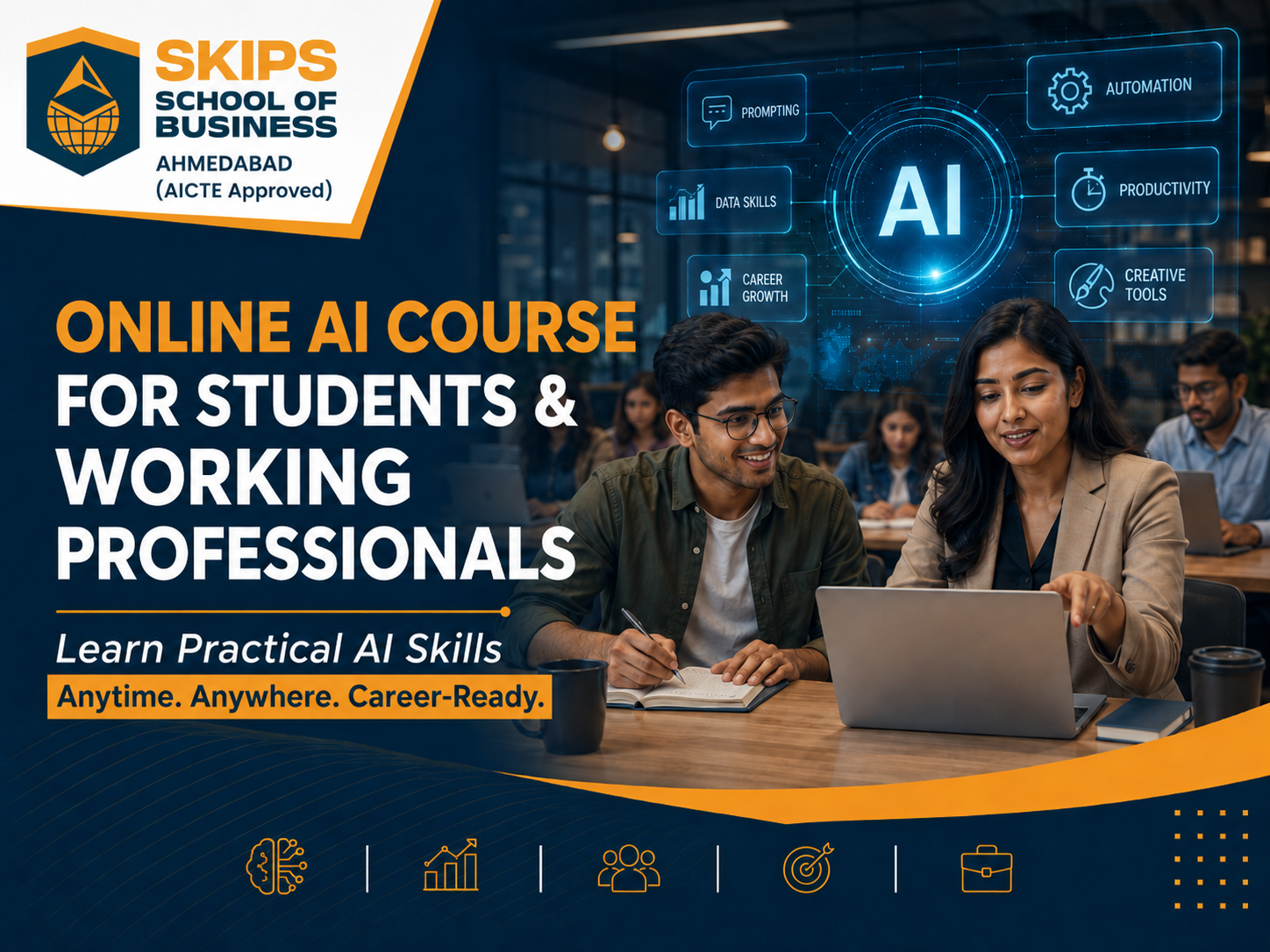
SKIPS University offers 30-day online AI certificate programmes for school and college students as well as working professionals, managers and entrepreneurs.
The programmes include approximately 52 learning hours, live weekend sessions, recorded learning modules, assignments, practical exercises, a capstone project and exposure to more than 25 AI and productivity tools.
No traditional coding knowledge is required to begin.
Students can explore the dedicated AI programmes for students here:
https://online.skipsuniversity.edu.in/students.html
Working professionals can explore the dedicated AI programmes for professionals here:
https://online.skipsuniversity.edu.in/working-professional.html
Why Learning AI Today Means More Than Learning ChatGPT
ChatGPT has introduced millions of people to Generative AI, but it represents only one part of a much larger AI ecosystem.
Modern AI tools can help people research information, analyse documents, generate ideas, create visual content, prepare presentations, summarise information, build assistants and automate multi-step workflows.
The important skill is therefore not memorising one particular AI tool.
It is learning how to think and work effectively with AI.
A useful AI course should help you understand questions such as:
How do large language models work at a practical level?
How should you structure a prompt for better results?
How can you identify AI hallucinations or unreliable information?
Which AI tool should you use for research, writing, analysis or automation?
How can you turn a repeated manual process into an AI-assisted workflow?
Where should human judgement remain part of the process?
These skills can remain valuable even as individual AI platforms change.
Who Can Learn AI?
One of the biggest misconceptions about Artificial Intelligence is that it is only for computer science students or software developers.
That is no longer true.
Today’s Generative AI tools are used across education, marketing, finance, HR, sales, operations, consulting, entrepreneurship, research, design and many other fields.
The SKIPS University programmes are structured for two broad audiences.
AI Course for Class 11 and 12 Students
School students can start learning AI before entering university.
For a Class 11 or Class 12 student, AI can be useful for:
- Understanding difficult concepts
- Creating revision plans
- Summarising long information
- Organising notes
- Researching project topics
- Preparing presentations
- Brainstorming ideas
- Improving communication
- Exploring career options
- Learning how AI works before entering college
Students from Commerce, Science and Arts backgrounds can participate because traditional coding knowledge is not a prerequisite.
The goal should not be to use AI to replace learning.
The better approach is to learn how to use AI as an intelligent study and productivity assistant while still applying independent thinking and academic integrity.
AI Course for College Students
For undergraduate and postgraduate students, AI skills can become useful beyond classroom assignments.
College students can learn how to apply AI to:
- Research
- Presentations
- Reports
- Data interpretation
- Resume preparation
- LinkedIn profiles
- Internship applications
- Project planning
- Content creation
- Business ideas
- AI assistants
- Workflow automation
A practical AI project can also give students something tangible to discuss during internship or job interviews.
Instead of simply writing “I know ChatGPT” on a resume, students should aim to demonstrate what they have actually created using AI.
AI Course for Working Professionals
For working professionals, the question is usually different.
They may already have experience in Marketing, Finance, Sales, HR, Operations, IT or Management. Their challenge is learning how AI can make their existing expertise more productive.
Practical applications can include:
- Researching a market more efficiently
- Summarising long reports
- Drafting professional emails
- Preparing presentations
- Creating meeting summaries
- Comparing information
- Generating first drafts of proposals
- Organising knowledge
- Automating repetitive administrative work
- Building internal AI assistants
- Creating lead-processing workflows
- Automating routine communication
- Improving personal productivity
Professionals do not necessarily need to become programmers.
They need to understand where AI fits into the work they already perform.
AI Course for Managers and Business Owners
Managers, founders, entrepreneurs and team leaders increasingly have another responsibility: deciding how AI should be adopted inside their organisation.
This requires more than knowing how to write prompts.
Managers need to understand:
- Which processes are worth automating
- Where AI can save time
- Where human approval is still required
- How company information should be protected
- How to verify AI-generated outputs
- How different tools can be connected
- How teams should use AI responsibly
- How to evaluate an AI workflow before deploying it
Learning these fundamentals can help decision-makers have more informed conversations about AI adoption.
Two AI Learning Tracks at SKIPS University
Rather than treating every learner as if they need exactly the same skills, SKIPS University offers two separate tracks.
Track 1: Fundamentals of AI
The Fundamentals of AI programme is intended for people who want to understand and use modern Artificial Intelligence effectively.
It starts with AI concepts and gradually moves toward practical applications.
Topics include areas such as:
- Artificial Intelligence fundamentals
- Machine Learning
- Deep Learning
- Generative AI
- Large Language Models
- Prompt Engineering
- Responsible AI
- AI research
- Productivity applications
- Content generation
- Professional communication
- AI-assisted presentations
- Personal branding
- Practical AI projects
The purpose is not to turn beginners into AI researchers in 30 days.
It is to develop enough understanding and hands-on experience for learners to use contemporary AI systems more thoughtfully and productively.
Who should start with Fundamentals of AI?
This track is particularly suitable for:
- Beginners
- Class 11 and 12 students
- College students
- Non-technical professionals
- Managers new to AI
- Entrepreneurs exploring Generative AI
- People who currently use ChatGPT casually and want a structured understanding
Track 2: Workflow Automation with No-Code AI
Once you understand how individual AI tools work, the next step is learning how they can work together.
That is where AI automation becomes useful.
The Workflow Automation with No-Code AI programme focuses on creating AI-enabled systems without requiring traditional software programming.
Learners explore concepts including:
- AI assistants
- AI chatbots
- No-code automation
- Workflow design
- Triggers and actions
- Webhooks
- AI-powered business workflows
- AI agents
- Tool calling
- Model Context Protocol
- Human-in-the-loop automation
- Multi-step workflows
- Capstone automation projects
Platforms covered include tools such as n8n and Google Opal, alongside major Generative AI platforms.
What does no-code AI automation mean?
No-code AI automation means creating workflows using visual interfaces and pre-built connections rather than writing a complete software application from scratch.
For example, a workflow could potentially:
- Receive a new enquiry.
- Organise the information.
- Ask an AI model to classify it.
- Generate a summary.
- Route it to the correct person.
- Save relevant information.
- Trigger a follow-up action.
The exact workflow depends on the tool, permissions and business requirements, but the principle is the same: combining AI with automation to reduce repetitive manual steps.
Who should consider the AI automation track?
It can be useful for:
- College students with some AI familiarity
- Working professionals
- Marketing teams
- Sales professionals
- Operations teams
- HR professionals
- Consultants
- Entrepreneurs
- Founders
- Managers
- People interested in AI agents and automation
Fundamentals of AI vs AI Workflow Automation
| Area | Fundamentals of AI | Workflow Automation with No-Code AI |
|---|---|---|
| Best starting point | Beginners | Learners ready to build |
| Coding required | No traditional coding required | No traditional coding required |
| Main focus | Understanding and using AI | Connecting and automating AI |
| Generative AI | Yes | Yes |
| Prompting | Strong focus | Used within workflows |
| AI tools | Yes | Yes |
| Chatbots | Introduction/application | Build practical assistants |
| Workflow automation | Introductory exposure | Core focus |
| AI agents | Introduction | Deeper practical use |
| Capstone project | Yes | Yes |
| Suitable for students | Yes | Yes |
| Suitable for professionals | Yes | Yes |
If you are completely new to AI, Fundamentals of AI is generally the more natural starting point.
If you already use AI tools comfortably and want to build practical automations, the Workflow Automation with No-Code AI programme may be more appropriate.
Some learners may choose to complete both sequentially.
What AI Tools Can Learners Explore?
A modern AI learning programme should not depend on only one platform.
The SKIPS University curriculum introduces learners to a broad AI ecosystem that includes major tools and technologies such as:
- ChatGPT
- Claude
- Google Gemini
- Microsoft Copilot
- Perplexity AI
- n8n
- Google Opal
- AI assistants
- AI agents
- Local and cloud AI tools
- Generative image tools
- Automation platforms
Across the programmes, learners receive exposure to 25+ AI and productivity tools and platforms.
The objective is not to memorise every button in 25 different tools.
Tools change quickly.
The more valuable skill is understanding the categories of problems each platform can solve and learning how to choose the right tool for a particular task.
What Is Prompt Engineering?
Prompt Engineering is the practice of giving an AI system clear instructions, useful context, appropriate constraints and a desired output format.
Compare these two instructions:
Weak prompt:
“Write about marketing.”
Better instruction:
“Explain three digital marketing strategies for a small Indian retail business. Write for a beginner, provide one example for each strategy and finish with a comparison table.”
The second instruction gives the AI:
- Context
- Audience
- Scope
- Structure
- Output requirements
Good prompting is not about finding one “secret prompt.”
It is about communicating clearly with an AI system, evaluating the response and refining the instruction when necessary.
Why AI Verification Matters
AI systems can generate convincing answers that are incomplete, outdated or incorrect.
This is often referred to as an AI hallucination.
Therefore, responsible AI use includes knowing how to:
- Verify important facts
- Check original sources
- Distinguish assumptions from evidence
- Protect personal or confidential information
- Recognise bias
- Review AI-generated calculations
- Apply human judgement before using an output
This is especially important for students preparing academic work and professionals making business decisions.
AI should improve judgement—not replace it.
How the 30-Day Online AI Programme Works
The programme follows a structured learning format rather than relying on a single long workshop.
The overall certified learning structure is approximately 52 hours.
| Learning Component | Approximate Learning Time |
|---|---|
| Recorded learning modules | 24 hours |
| Live weekend classes | 8 hours |
| Practical assignments | 10 hours |
| Capstone project | 5 hours |
| Self-practice and labs | 5 hours |
| Total | 52 hours |
Recorded content is organised into shorter modules that learners can complete around their school, college or work schedule.
A live interactive session is conducted on Saturdays during the four-week programme.
This allows participants to learn concepts independently during the week and then use the live session for practical application, discussion and mentor interaction.
Why Projects Matter When Learning AI
Watching demonstrations is easy.
Building something yourself is where real learning begins.
That is why assignments and a capstone project are useful parts of an AI programme.
A student might build something that supports:
- Study planning
- Research
- Content organisation
- Portfolio creation
- A simple AI assistant
A working professional might focus on:
- Reporting
- Lead management
- Research
- Communication
- Document processing
- Business workflow automation
The project becomes evidence that the learner has moved beyond watching tutorials and has actually applied what was taught.
Can You Learn AI Without Coding?
Yes, you can begin learning practical Generative AI and no-code AI automation without traditional programming knowledge.
Many modern AI platforms provide conversational or visual interfaces.
You can learn:
- Prompt Engineering
- AI research techniques
- Generative AI
- Chatbot concepts
- AI productivity
- No-code workflows
- AI assistants
- Automation fundamentals
without starting with Python, Java or another programming language.
However, coding remains valuable for people who later want to build advanced AI applications, train models or work in specialised AI engineering roles.
A no-code course should therefore be viewed as an accessible entry point into practical AI—not as a substitute for an engineering degree or advanced computer science education.
Can Students Use AI for Assignments?
AI can help students learn, but it should be used responsibly.
Good uses include:
- Explaining a difficult concept in simpler language
- Creating practice questions
- Suggesting a study plan
- Organising notes
- Brainstorming project ideas
- Improving the structure of a presentation
- Comparing viewpoints
- Finding areas that need further research
Students should avoid submitting unverified AI-generated content as their own work.
The goal should be to use AI to become a better learner rather than to avoid learning.
How Can Working Professionals Use AI at Work?
The best AI applications often start with small repetitive tasks.
Consider a professional who spends significant time every week:
- Summarising information
- Drafting similar emails
- Preparing reports
- Researching competitors
- Organising meeting notes
- Updating documents
- Answering repetitive queries
AI may be able to assist with part of these processes.
The professional still provides the business knowledge, context, decision-making and final review.
This combination—human expertise supported by AI—is more realistic than assuming AI should independently perform every task.
What Do Learners Receive After Completing the Programme?
Learners who successfully meet the programme requirements receive a university-issued verifiable certificate from SKIPS University.
Participants also work on practical assignments and a capstone project.
The current programme structure provides access to recordings and learning materials for one year, allowing participants to revisit concepts after completing the 30-day programme.
For students, the project can become part of a learning portfolio.
For professionals, it can demonstrate practical AI application alongside existing industry experience.
Why Choose a Structured AI Course Instead of Only Watching Free Videos?
There is a huge amount of free AI content online.
That is useful—and learners should absolutely make use of it.
The challenge is that online content is often:
- Scattered across different platforms
- Created for different skill levels
- Focused on individual tools
- Quickly outdated
- Missing assignments
- Missing mentor interaction
- Missing a clear learning sequence
A structured programme can provide a defined path:
Understand → practise → apply → build → receive feedback.
For many learners, that structure can make it easier to move from casually experimenting with AI to developing usable skills.
Is This an AI Course Only for Ahmedabad Students?
No.
The AI programmes are delivered online, so participants are not limited to Ahmedabad.
SKIPS University has campuses in Ahmedabad and Gandhinagar, Gujarat, while these Future Skills programmes are designed for online participation.
This allows school students, college students and professionals from different locations to participate without relocating.
Which Online AI Course Should You Choose?
Choose based on what you want to be able to do after completing the programme.
Choose Fundamentals of AI if you want to:
- Understand Artificial Intelligence
- Learn Generative AI
- Improve your prompting
- Research more effectively
- Use AI for study or work
- Learn responsible AI practices
- Explore multiple AI platforms
- Build a practical AI project
Choose Workflow Automation with No-Code AI if you want to:
- Build AI-powered workflows
- Create AI assistants
- Explore chatbots
- Use n8n
- Learn visual automation
- Understand AI agents
- Connect tools and processes
- Build a working automation project
Online AI Course for Students
Class 11, Class 12, undergraduate and postgraduate students can explore the dedicated SKIPS University student programme page for the current curriculum, batch information and admission enquiry.
Explore AI Programmes for Students:
https://online.skipsuniversity.edu.in/students.html
The student programme is designed around study productivity, practical AI skills, projects, portfolio development and preparation for a future in which AI literacy is increasingly useful.
Online AI Course for Working Professionals
Executives, managers, entrepreneurs, consultants and working professionals can explore the dedicated professional programme page.
Explore AI Programmes for Working Professionals:
https://online.skipsuniversity.edu.in/working-professional.html
The professional track places greater emphasis on workplace productivity, business applications, professional communication, AI-assisted research and practical automation.
Frequently Asked Questions About the Online AI Course
What is the duration of the SKIPS University online AI course?
Each programme runs for approximately 30 days and includes around 52 hours of structured learning activities.
Is the AI course completely online?
Yes. The Future Skills AI programmes use an online learning format that combines recorded modules with live faculty-led sessions.
Do I need coding knowledge to join?
No traditional coding background is required to begin either the Fundamentals of AI or Workflow Automation with No-Code AI programme.
Can Class 11 and 12 students learn AI?
Yes. The student programme is designed for Class 11, Class 12 and college students from different academic streams, including Commerce, Science and Arts.
Can non-IT working professionals learn AI?
Yes. AI is increasingly used in Marketing, Sales, Finance, HR, Operations, Management and Entrepreneurship. A computer science background is not mandatory for learning practical Generative AI and no-code automation.
What is taught in the Fundamentals of AI programme?
The programme covers AI fundamentals, Generative AI, Large Language Models, Prompt Engineering, responsible AI, research, productivity, communication, creative applications and a practical capstone project.
What is the no-code AI automation course?
Workflow Automation with No-Code AI teaches participants how AI can be connected to practical workflows using visual platforms, assistants, chatbots, triggers, integrations and AI-agent concepts without requiring conventional application development.
Which AI tools are covered?
Learners receive exposure to more than 25 AI and productivity tools and platforms, including major Generative AI systems and workflow-automation technologies.
Does the programme include live classes?
Yes. The current learning structure includes four live Saturday sessions of approximately two hours each, alongside recorded learning and practical work.
What happens if I miss a live session?
The programme provides access to session recordings. Current programme information states that learners receive one-year access to recordings and course materials.
Is there a practical project?
Yes. Practical assignments and a capstone project are part of the programme structure.
Will I receive a certificate?
Learners who successfully complete the programme requirements receive a digitally verifiable certificate issued by SKIPS University.
Is this AI course suitable for beginners?
Yes. Fundamentals of AI is particularly suitable for beginners who want to develop an understanding of AI before moving into more advanced applications.
Should I learn AI fundamentals or automation first?
Someone completely new to AI will generally benefit from beginning with AI fundamentals. Learners who already understand common AI tools and prompting may move into workflow automation.
Is an AI certificate enough to get an AI job?
A certificate alone does not guarantee employment.
For specialised careers such as Machine Learning Engineer or AI Engineer, employers may require programming, mathematics, computer science fundamentals and substantial technical experience.
The programme is better viewed as a way to develop practical AI literacy, improve productivity and demonstrate applied skills through projects.
Can AI help students with research and presentations?
Yes. AI tools can help organise information, explain concepts, generate outlines and improve presentation structure. Students should still verify facts, cite appropriate original sources and follow their school or university’s academic-integrity policy.
Can AI automate office work?
Certain repetitive steps in office workflows can be assisted or automated using AI and workflow tools. The suitability of automation depends on the process, data sensitivity, reliability requirements and need for human approval.
A Practical Way to Start Learning AI
You do not need to understand every AI model or use every tool available.
Start with four questions:
What can AI do?
How do I communicate with it effectively?
How do I verify what it gives me?
How can I apply it to a real problem?
Once those foundations are clear, automation, agents and more advanced AI applications become easier to understand.
The most useful AI skill is not simply knowing a collection of tools.
It is knowing how to identify a problem, choose the right tool, provide the right context, evaluate the output and turn the result into something useful.
Start Learning AI with SKIPS University
SKIPS University Future Skills offers structured online AI learning for two different stages of the journey.
Fundamentals of AI helps learners understand and use modern AI effectively.
Workflow Automation with No-Code AI helps learners move from using individual AI tools to building practical workflows, assistants and automations.
Both programmes are designed around practical application rather than passive learning.
For School and College Students
Explore programme details, curriculum and enquiries:
https://online.skipsuniversity.edu.in/students.html
For Working Professionals, Managers and Entrepreneurs
Explore the professional programme:
https://online.skipsuniversity.edu.in/working-professional.html
Programme Duration: 30 Days
Learning Duration: Approximately 52 Hours
Learning Format: Recorded + Live Online Sessions
Practical Learning: Assignments + Capstone Project
AI Tools: 25+ tools and platforms
Coding Requirement: No traditional coding prerequisite
Certificate: Verifiable certificate from SKIPS University
Recording Access: 1 Year
Admissions Contact: +91 95121 30000
Email: info@skipsuniversity.edu.in
Programme curriculum, tools, schedules, faculty, admission criteria and other programme details may be updated as AI technologies evolve. Applicants should refer to the current SKIPS University programme pages for the latest information.


